
The Sacred History of Govardhan
Govardhan, located in the heart of the Braj region of Uttar Pradesh, is one of the most sacred pilgrimage destinations in Hinduism. Revered as the divine hill lifted by Lord Krishna, Govardhan holds immense religious, cultural, and historical significance. For centuries, devotees have worshipped Govardhan Hill as a direct manifestation of Lord Krishna and a symbol of divine protection, devotion, and faith.
The history of Govardhan is deeply rooted in ancient Hindu scriptures, particularly the Bhagavata Purana, Vishnu Purana, and other Vaishnava texts that narrate Lord Krishna’s divine pastimes in Braj.
Ancient Origins
According to Hindu tradition, Govardhan Hill existed long before the birth of Lord Krishna and is considered a sacred natural formation blessed by divine presence. Ancient legends describe Govardhan as a celestial hill that descended to Earth to participate in Lord Krishna’s divine pastimes.
The hill became the center of devotion and worship during Krishna’s childhood years in Braj, where he spent time grazing cows, playing with his friends, and performing various divine leelas.
The Govardhan Leela
The most significant event in Govardhan’s history is the famous Govardhan Leela, one of the greatest miracles associated with Lord Krishna.
According to sacred scriptures, the people of Braj traditionally worshipped Lord Indra, the god of rain, seeking protection and prosperity. Lord Krishna encouraged them to worship Govardhan Hill instead, explaining that the hill provided food, water, shelter, and sustenance to the community.
Angered by this change, Indra unleashed devastating storms and torrential rains upon Braj. To protect the villagers, Lord Krishna lifted Govardhan Hill on the little finger of his left hand and held it aloft for seven days and seven nights. The people and cattle of Braj took shelter beneath the hill and remained safe.
Realizing Krishna’s divine nature, Indra apologized and accepted his supremacy. This sacred event established Govardhan as one of the holiest places in Hinduism and continues to be celebrated annually during Govardhan Puja.
Govardhan in Ancient Scriptures
Govardhan is prominently mentioned in numerous Hindu scriptures, including:
- Bhagavata Purana
- Vishnu Purana
- Garga Samhita
- Hari Vamsa
- Brahma Vaivarta Purana
These texts describe Govardhan as a sacred embodiment of Lord Krishna and an integral part of the divine Braj Mandal.
Development as a Pilgrimage Center
Over centuries, Govardhan evolved into a major center of pilgrimage and devotion. Saints, sages, and devotees from various Vaishnava traditions visited the region, establishing temples, ashrams, and sacred kunds around the hill.
Prominent spiritual leaders such as:
- Sri Chaitanya Mahaprabhu
- Vallabhacharya
- Rupa Goswami
- Sanatana Goswami
- Narayan Bhatt
played significant roles in preserving and promoting Govardhan’s spiritual importance.
Their efforts helped establish the Govardhan Parikrama tradition, which remains one of the most revered pilgrimage practices in India.
Sacred Kunds and Heritage Sites
Throughout history, numerous sacred sites developed around Govardhan Hill, including:
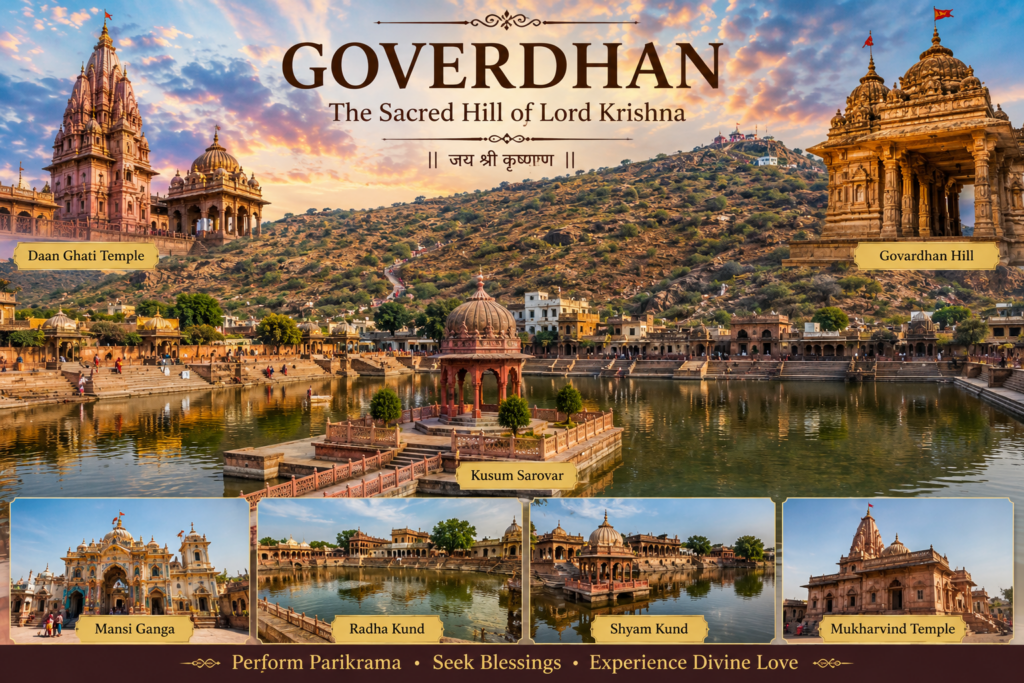
Radha Kund
Considered the holiest of all sacred ponds, Radha Kund is associated with the divine love of Radha and Krishna and holds special importance in Vaishnavism.
Shyam Kund
Located beside Radha Kund, this sacred pond is believed to have been created by Lord Krishna himself.
Kusum Sarovar
A beautiful historical reservoir surrounded by magnificent sandstone architecture, Kusum Sarovar is associated with the flower-gathering pastimes of Radha and the gopis.
Mansi Ganga
According to tradition, Mansi Ganga manifested from Lord Krishna’s mind and became an important pilgrimage site for devotees.
Daan Ghati
This sacred area commemorates Krishna’s playful interactions with the gopis and remains one of Govardhan’s most visited temples.
Govardhan During the Medieval Period
During the medieval era, Rajput rulers and wealthy devotees contributed significantly to the development of Govardhan’s temples, ghats, and pilgrimage infrastructure. Many of the region’s historic structures, kunds, and temples were renovated and preserved during this period.
Govardhan also became a center of Bhakti movements that emphasized devotion to Lord Krishna through prayer, kirtan, and service.
Govardhan Today
Today, Govardhan remains one of the most important pilgrimage destinations in India. Millions of devotees visit every year to perform the sacred 21-kilometer Govardhan Parikrama, offer prayers at the holy kunds, and seek blessings from Govardhan Maharaj.
The town continues to preserve its ancient spiritual traditions while welcoming pilgrims from around the world who come to experience its divine atmosphere and timeless heritage.
The Eternal Significance of Govardhan
For devotees, Govardhan is not merely a hill but a living manifestation of Lord Krishna’s grace and protection. Its history represents the triumph of faith over pride, humility over arrogance, and devotion over material power.
Every stone of Govardhan is considered sacred, and every step taken during the Parikrama is believed to bring spiritual merit and divine blessings.
Govardhan stands today as an eternal symbol of Lord Krishna’s love for his devotees and remains one of the holiest spiritual destinations in the world.